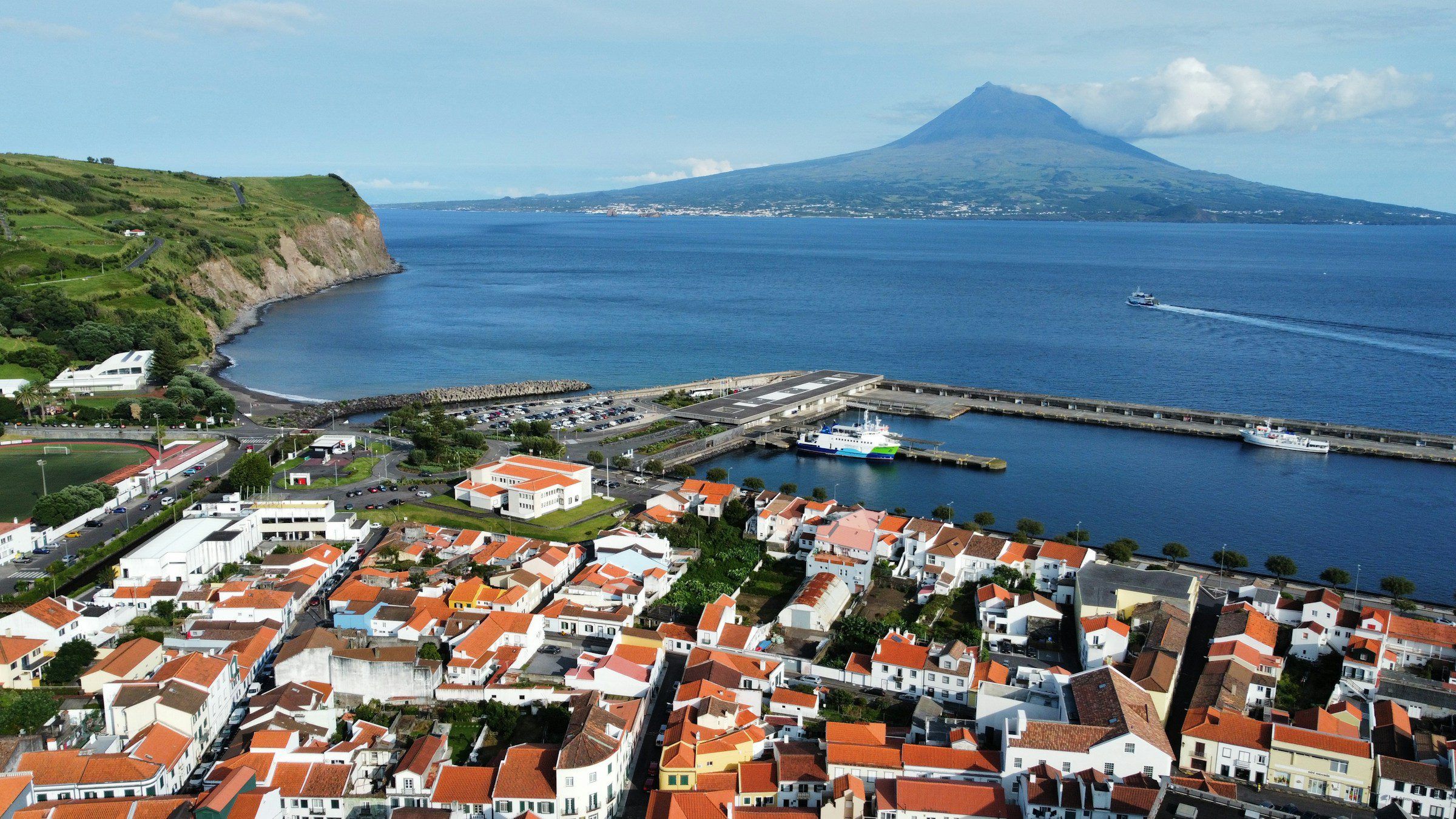
Where to stay on Pico and Faial, and how we help you choose your villa
Because the ferry makes these two islands one destination, the real question is only which shore you wake up on. Horta, on Faial, is the harbour town: the marina, the painted quay, the bars full of people who arrived by sea, and the mountain filling the window across the water. It is the sociable choice and the easier one for a group that wants somewhere to walk to. The Madalena side of Pico puts you inside the lava vineyards with the summit behind the house, and Lajes, round on the southern coast, puts you closest to the sperm-whale grounds.
The houses are unlike anywhere else we cover. On Pico the best of them are lava-stone buildings inside the walled vineyard enclosures, low, thick-walled and restored with a lot of glass at the sea end, often old adegas that have been rebuilt as houses. Around Horta you find taller town houses with harbour views and gardens, and a scattering of newer coastal houses west of the marina. Nothing here is large by mainland standards, so a big group usually means two houses rather than one, and we will say so early.
We do not list villas on this site. Tell us your dates, who is coming and the budget band you have in mind, and we come back with a shortlist from trusted local agencies and owners, then arrange the boats, the tastings and the island days around it. More on the two islands is in Luxury Villas on Pico and Faial.
Two islands that only make sense together
Pico and Faial sit facing each other across a channel of about 8 km, with Horta on the Faial side and Madalena on the Pico side, and Lajes do Pico around on the southern coast. The ferry between the two harbour towns takes about 30 minutes, runs many times a day in season, and costs from around €7 as a foot passenger. That crossing is the whole reason to treat these as one destination: you can sleep in Horta and climb on Pico, or sleep in Madalena and sail from Faial, without renting a second car or rebooking a second hotel.
Faial is the harbour island. Horta has been a transatlantic yacht stopover for generations, its quay painted by crossing crews and its bars full of people who arrived by sea. Pico is the vertical one: black lava fields, dry-stone vineyard walls and a mountain that fills the skyline from the Horta waterfront across the channel.
Whales, and where you leave from
This is one of the strongest whale-watching destinations in the Atlantic, and the departure port genuinely matters. Boats leave from Madalena marina, the Lajes do Pico nautical centre and Horta Marina, but Lajes sits roughly 10 minutes from the prime sperm-whale grounds against roughly 30 minutes from Madalena or Horta — which on a three-hour trip is a meaningful amount of extra time with animals.
The season is wider than the destination season: trips run April to October, sperm whales are resident year-round, migrating baleen whales peak from March into early June, and Atlantic spotted dolphins arrive in late June. Boats are held to conduct rules on distance, numbers and observation time, and swimming with whales is simply forbidden. See whale-watching from Pico and from Horta.
The mountain
Mount Pico is the reason the skyline looks like this, and it is worth knowing what it actually is before you choose a side of the channel. It is a regulated nature reserve with one legal trail, mandatory registration, GPS trackers and daily caps, and the summit stands at 2,351 m. That is a serious mountain day, not a viewpoint walk, and the daily cap means it is decided well in advance rather than on the morning.
Where somebody staying with us wants to go up, the registration, the cap and a recognised local guide are handled as part of the stay. The guide leads it and the guide decides whether it runs.
Wine, lava and the rest of the day
Pico’s vineyards are grown inside walled lava enclosures, a landscape described everywhere as UNESCO World Heritage. Three addresses are open to visitors, from the 1949 cooperative at Madalena to a small adega with a museum at São Roque. On Faial, the standard island day is the Caldeira crater and the Capelinhos volcano with its half-buried lighthouse.
Weather, honestly
Sea state, not rain, decides what runs here — swell and wind cancellations are routine even in summer, and May to October carries the calmest windows. When a boat stands down for weather, free rebooking or a full refund is the market norm, though the terms belong to each business and we confirm them in writing first.
Tell us your dates, who is coming and which of these matters most, and we come back with real options and real prices: the house, the boats, the tastings and the island days. Nothing is booked until you say so. Start at Request availability.
By service: luxury villas, boat charters, wine tours and private tours across all of our destinations.