Where to stay
Puglia is long, and the difference between one base and another is an hour of driving every day for a week. Three areas carry the houses worth taking.
The Valle d’Itria is the heartland: Alberobello, Locorotondo, Martina Franca and Cisternino sit roughly ten to fifteen minutes from one another, with Ostuni on its white hill above the olive plain to the east. This is masseria and trullo country. The orecchiette classes people come for are held in trulli and farmhouses in the countryside around Martina Franca, a few minutes by car from Alberobello itself, which tells you where the real landscape is.
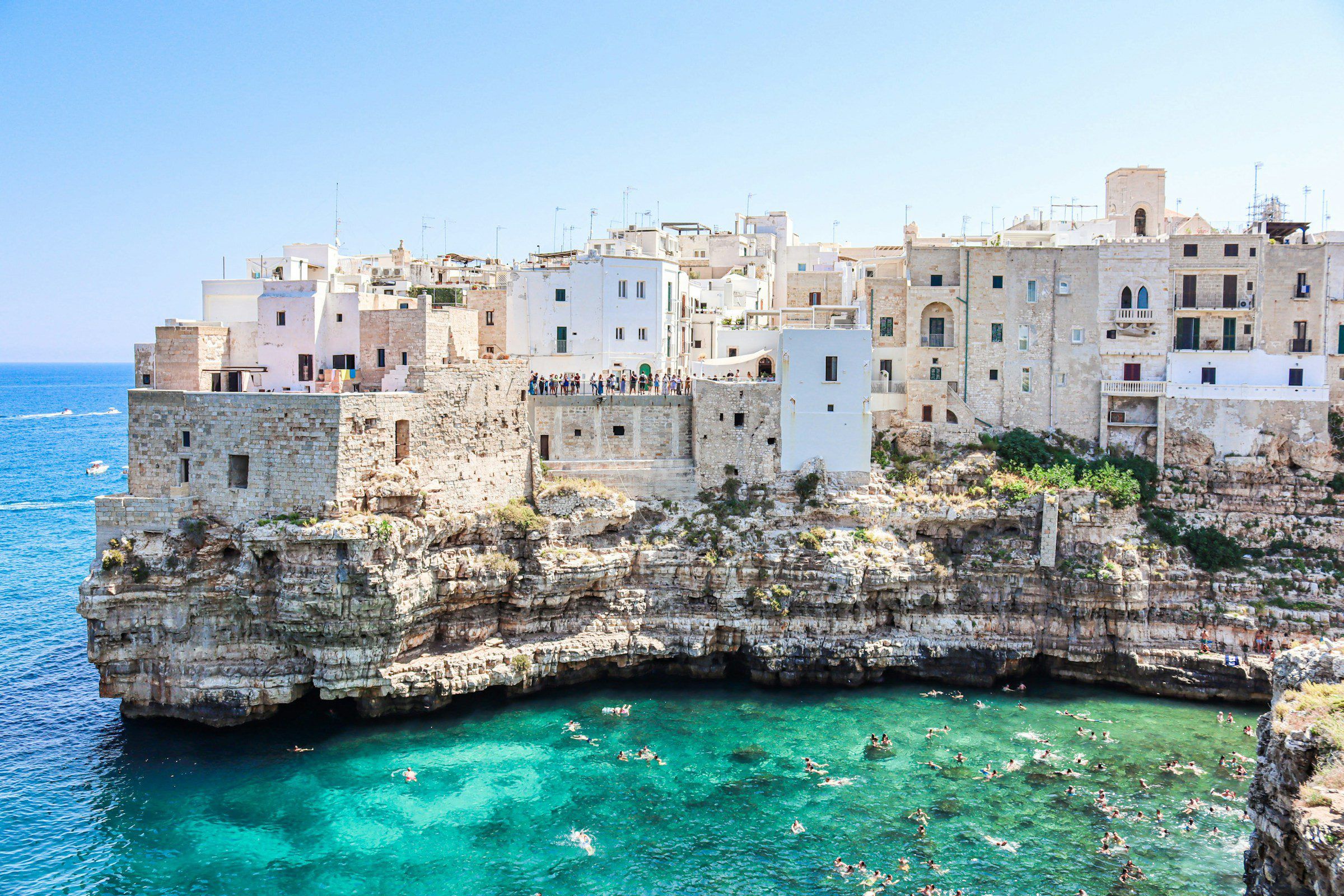
The Adriatic coast between Polignano a Mare and Monopoli is the swimming and dinner end. Polignano’s boats board at San Vito, the little harbour hamlet just north of the centre, and Monopoli works from the old port beside the walled town. Be clear eyed about the shore: this is cliff, rock platform and small cove rather than a long beach.
The Salento, the deep south around Otranto, Gallipoli and Santa Maria di Leuca, has two coasts and better beaches. Leuca sits where the two seas meet, and the boats there run cave circuits on whichever side is calm that morning. It is further from the airports, and worth it if swimming is the point of the trip.
The kinds of property you will find here
A masseria is a fortified farm estate: high walls, a courtyard, thick stone, olive groves around it, and at the top of the market a cook, a housekeeper and somebody who keeps the garden. The ones open to visitors as working producers give you the flavour of the type, with an underground mill and a grove of millenary trees behind the house. A masseria is the right answer for a celebration, a big table, and a group that wants one place to be all week.
A trullo estate is the other icon: conical drystone buildings, usually several knocked into one property, cool when everything outside is not. They are beautiful and they photograph better than they sleep, because each cone is a small room. Read the bedroom plan carefully before committing a large party to one.
A coastal villa trades the walls for the water: a terrace above the rocks, a pool, and a walk or a short drive into Polignano or Monopoli for dinner. Newer, usually less staffed, and the easiest with children.
When to come
The visitor season runs May to October, heaviest from June to August, and the region has become genuinely busy: Puglia recorded 6.7 million arrivals in 2025, up 12.9 per cent on the year. The best houses in the peak weeks are taken a long way ahead.
The shoulders are the local answer, and the search data agrees: interest in visiting in May and in October is as strong as the general best time question. The sea is usually at its warmest from July into September; the grape harvest falls around August and September and the olive mills work from October into November. Land based days run year round here, unlike the boats, which is what makes an off season week work at all.
What we arrange around the stay
The chef, first. The chefs working here are based around Ostuni and the Valle d’Itria and cook in villas and masserie across the surrounding towns; none of them publish rates, so every dinner is quoted per menu and party. See private chef in Puglia or a cooking class in Monopoli.
On the water, the Polignano sea caves boat tour and a yacht charter from Monopoli; inland, the Valle d’Itria wine tour through grapes most people have never drunk, Minutolo, Verdeca and Bianco d’Alessano among them, and an olive oil morning near Ostuni, which has to be booked ahead because both estates take visits by reservation only. For a day out with a qualified guide there is the trulli towns day or Matera and Alberobello, which crosses into another region legally because Italian guiding runs on a national register.
Arrival is a car with a driver rather than a taxi rank: Bari Airport to Ostuni or Bari Airport to Polignano a Mare, which is about 40 minutes. The same companies sell hourly hire and half day town runs, which is often the better buy on a day when you want a driver rather than a guide.
What to send us
Dates and how firm they are, the number of adults and children and how they can share, the bedrooms you need, a budget band per week, and the things that decide it: a pool the children can actually use, walls and privacy, a table for everyone outside, walking distance to a town, air conditioning in every bedroom.
How we help you choose
We do not display properties on this site, and that is deliberate. You tell us the dates, the group and a budget band; we come back with a shortlist from trusted local agencies and owners, with what each house includes and what it does not. The booking is then made with that agency or owner, on their contract, their deposit schedule and their cancellation terms. The rental paperwork stays with them: every Italian holiday let has to carry a CIN, the national identification code issued through the Ministry of Tourism database and displayed at the property, and obtaining it is the owner’s job.
Request availability with your dates, your numbers and whether you want the coast or the valley.